
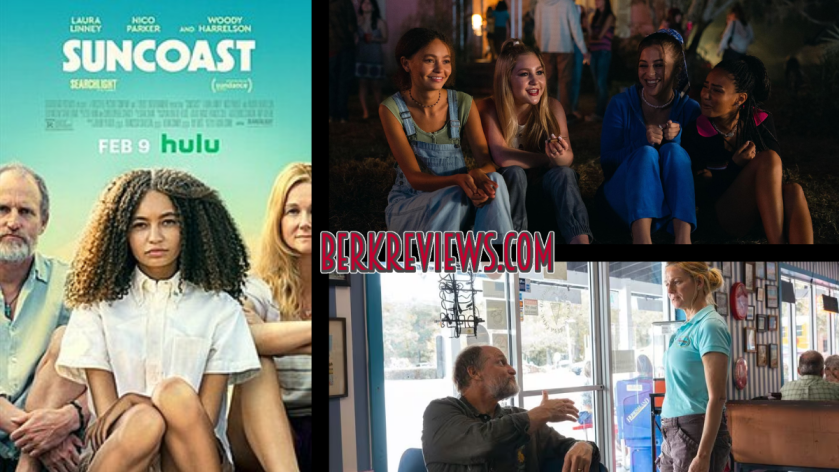
Movies about grief, guilt, regret, and living while others pass are going to resonate for many people. We may see ourselves in the characters as they struggle to come to terms with living their lives while someone they love dies. Is it selfish to want to enjoy the many fruits available on this mortal coil if someone you love is slowly fading away? It seems Laura Chinn is working through many of these ideas in Suncoast, a film that she both wrote and directed.
Suncoast is an emotionally impactful film with three great performances. Set in 2005, Doris (Nico Parker) has been helping to take care of her brother who is dying of brain cancer, while her mother (Laura Linney) works multiple jobs to pay the bills. It is at the point where he must be put in hospice, which leads Doris to experience numerous conflicting feelings. Set in Clearwater, Florida, he is going to the same place where protesters amass outside to debate the Terri Schiavo situation. Paul (Woody Harrelson) is one of the protestors, and he and Doris form an unlikely friendship while she navigates this difficult moment in her life.
First, Harrelson has an uncanny ability to be endearing and charming while making fun of young people. He was an absolute powerhouse in Edge of Seventeen doing exactly that – and while Paul is a little kinder, it is very much the same dynamic in play here. He can strike the correct tone, and truly has entered into a Yoda-like phase in his career (think back to Hunger Games…Haymitch is kind of Katniss’s Yoda).
Linney gets some incredibly powerful and moving monologues in this film. Her character is hard to like, as she is neglectful of Doris and her feelings. There is one moment when she is speaking with a Grief Counselor, who is extremely telling about the mother/daughter dynamic, that was a total gut punch. Still, Linney is such a good actress that despite the many moments where her character could totally lose any sympathy from the audience, her performance keeps us hoping there are in fact redeemable qualities.
Parker gives a breakout performance here. It’s mostly quiet due to the character’s nature, but she absolutely shines. Much of the film focuses on Doris finally feeling comfortable enough to start making friends at her private school. Chinn’s script is surprisingly grounded in the relationships with her peers, which are initially are taking advantage of Doris’s absent parent situation to throw big house parties – but gradually, they become true…but questionable…friends. Parker plays her conflicted nature extraordinarily well. You can see the various emotions bubbling beneath the surface, and when they finally rise, she is capable of delivering them in an impactful way.
The setting and the juxtaposition of the Schiavo protests, the religious debates embedded in it and at the school, and Paul’s character are the hardest elements to fully grasp when attempting to absorb and understand what Chinn is attempting to say. It may be that I just don’t have enough context, but it feels like many of the ideas are referenced yet somehow not fully worked through. Doris gets a moment in class to comment on the controversy surrounding Schiavo, and her own feelings with the impending loss of her brother. What she says feels like it amounts to a bit of nothing, but the other characters remark on how deep she is. It’s not enough to ruin the film by any means, but it’s this disconnect that stops it from reaching its full potential.
Suncoast is likely to leave you red-eyed and tissue-less. My wife and I both sat crying during a few key scenes. There was also an abundance of genuine laughs and a real love for the characters. While I don’t feel the film fully resolved some of the topics it brought up, it was successful in getting me thinking about it all.
Suncoast is currently available to stream on Hulu.
Rating: Not Quite Golden, Ponyboy.
 Berkreviews.com