
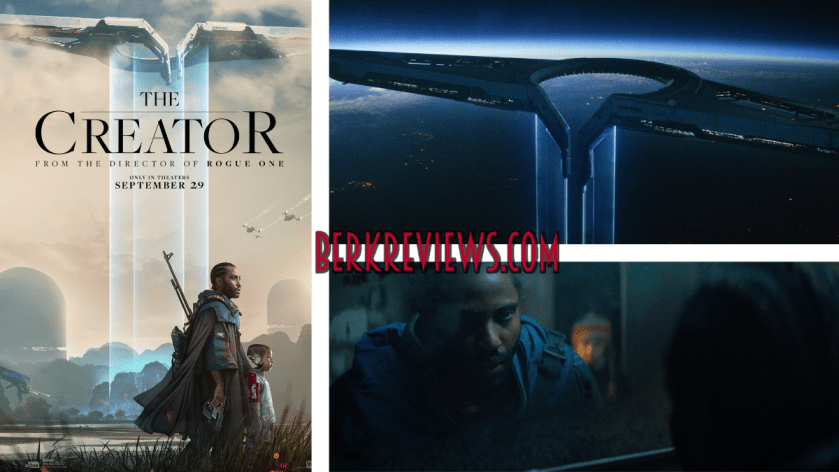
Director Gareth Edwards’ new film, The Creator, has incredible visuals and a compelling premise. The world is full of robots with artificial intelligence, and they have been peacefully living alongside humans for quite some time. Of course, that relationship apparently sours, and the robots set off a nuclear weapon in Los Angeles. The war between America and the robots, who are now living in New Asia, has been raging ever since – and the threat of a new weapon makes America take its last stand. Fans of the science fiction genre will recognize a lot of familiar ground in this premise, and there are definitely clear influences in the film. Where this film falls short is in its inconsistent storytelling and character development, fueled by bad dialogue and some ideas that don’t seem to care about the internal logic of its own world.
The film’s protagonist is Joshua, played by John David Washington. He has a negative history with the robots, as his family died in the blast and left him without an arm and a leg – a detail that the film doesn’t do anything with, outside of having him adorn some cool prosthetics. His wife, Maya (Gemma Chan), is killed in a raid by his own government – but he’s brought back to retrieve the new weapon, and turns out to be a young robot child (Madeleine Yuna Voyles). You might wonder if robot children are the norm…but no, that’s not a normal part of this world, and that’s what makes her special.
Here is a fairly common genre element that audiences have seen time and time again. A grizzled man who lost their chance to be a father takes on the parental role of a young special being. The great films that use this take the time to develop the relationship and build the connection between the two characters. While both actors perform admirably, the writing and storytelling never give the audience any sense of connection, outside of just telling us they care.
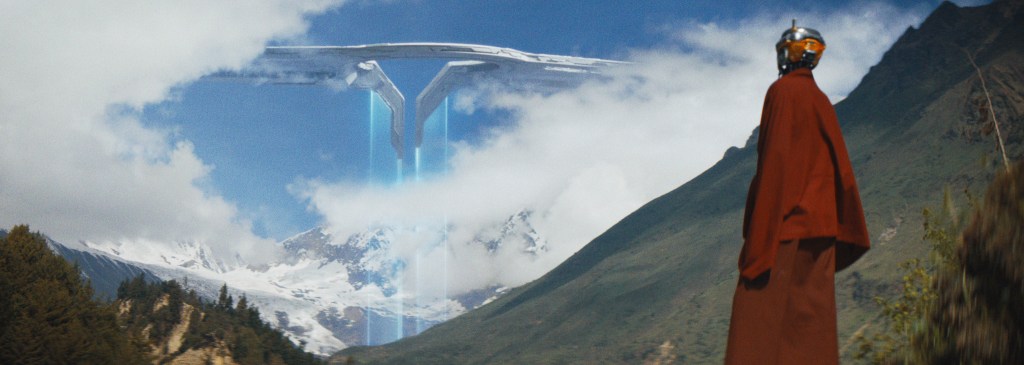
One of the biggest problems with the film’s storytelling is the giant ship, which is essentially a United States Deathstar. We see it used, and its power is demonstrated early on. However, we see military units sent into locations where the ship is on its way to drop bombs, creating these artificial “we’ve got six minutes” situations. If your ship is so powerful, why bother sending in soldiers to die? In one of the more brutal war scenes, US tanks are seen running over huts of robots and New Asian citizens. They are clearly at a huge advantage, and in the distance, the giant ship can be seen working its way to the village. The best thing the US can do is send in running robot bomb men. In the right context, the idea would be cool and unique. Here, it feels like an idea that someone refused to scrap, and forced it in a moment that just doesn’t make any logical sense. That is the film’s biggest recurring theme: ideas that feel more out of place and crammed in than functional to a successful story.
The final complaint about The Creator is essentially illustrated in the previous sentence; it is style over substance. The beauty of the sci-fi genre is the ability to tackle challenging ideas through allegory and metaphor. Robots and aliens, spaceships, and laser swords – as like a spoonful of sugar – help audiences swallow the commentary on political strife, existence, humanity, and other challenging topics. While those topics are present in The Creator, the commentary or function of them feels superficial. AI is such a relevant topic in the real world, so to see a beautiful science fiction film focus on it and add nothing to the conversation is disappointing.
The Creator is in theaters everywhere on September 29.
Rating: Not A Total Waste of Time
 Berkreviews.com