
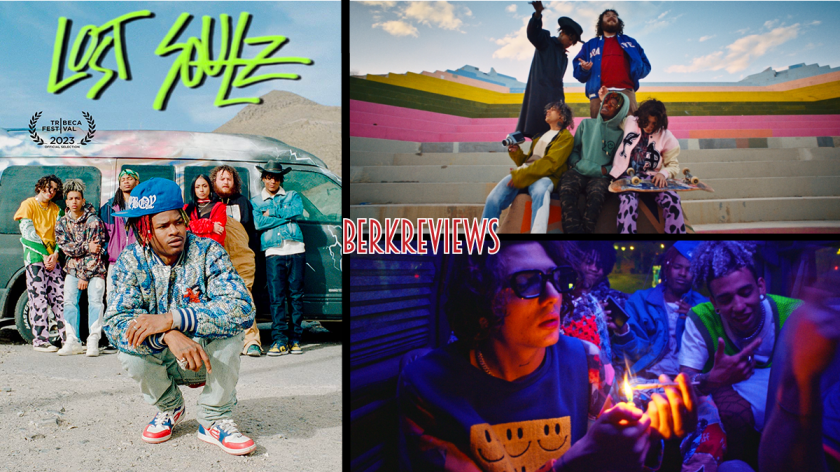
Lost Soulz is director Katherine Propper’s debut feature film that shines at times and suffers from a consistent film language. Sol (Suave Sidle) is an up-and-coming rapper who is showcasing his talent at a party. His performance catches the attention of Nina (Krystall Poppin) who manages a band of other rappers and performers who are currently heading to a big show in Texas. When cops bust up the party, Sol abandons his best friend Wesley (Syanda Stillwell) and accepts an offer from Nina to join the group as they travel by van across Texas.
Tonally, Propper’s film feels a lot like Jonah Hill’s Mid90s or Crystal Moselle’s Skate Kitchen in the best way possible. The stakes are definitely high for Sol, but the film still embraces the hang-out road-trip vibe of a new friend group. Initially, everything seems to be going Sol’s way, but the guilt of leaving his surrogate family behind never leaves him. The new guys are very accepting of Sol and there doesn’t appear to be any competition or jealousy among the guys. In that way, the film is quite refreshing and inviting to the audience. We are in the van with the guys just embracing life and chasing the dream. One can easily spot the American Neorealism style often found in films by Chloé Zhao (Nomadland, The Rider) or Sean Baker (Florida Project, Red Rocket) in Propper’s approach of blending a fictional narrative with actual musicians playing versions of themselves. In these elements, the film really stands out and is quite enjoyable.
The film feels the most unsure of itself with the deployment of some of the aesthetic choices. There is an early establishment of Sol’s memories of Wesley being shown with a filmstrip effect on the footage. It implies this old home video idea that easily works as a memory. That is until Propper uses it erratically for random shots throughout the film. Sometimes the shots are likely in the past, other times it’s in the moment of a photo session, or a trip to the zoo. This same problem is used in regards to aspect ratio when some shots are implied to be from a spectator’s cellphone or our characters watching a social media post. Yet, this is not used consistently and rather just feels like spur-of-the-moment editing flourishes rather than helping to paint the picture of the narrative. Cinematic language should be established by the filmmaker within the film, but it can really hurt the storytelling if it is inconsistent. At times these flourishes kick the audience out of the immersion of the film and draw attention to the fact that they are watching a movie. When used intentionally, that can be a powerful tool. Here, it seems more accidental.
Lost Soulz is definitely worth the time of any audience. The characters seem to have complex lives that existed prior to our joining them. Propper’s story isn’t too concerned with spelling out who these guys were, but we get a good feeling that they are doing the best they can with the talents they possess. The film’s tone is somber and reflective of the choices that we make in life in the pursuit of what we deem important. There is definitely talent here and with a little more opportunity and focus we will likely see a strong new voice rise in the film world.
Lost Soulz debuts at Tribeca on June 11.
Rating: Decent Watch
 Berkreviews.com
One comment